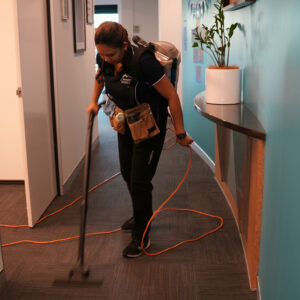
Most people think starting a business is about choosing the “right idea.” It is not. It is about choosing the right reality, and most people do not know what that actually looks like. Urban Clean founder, Damien Boehm has watched hundreds of buyers walk into entrepreneurship with confidence and walk out again, not because they are incapable, but because no one ever told them the real rules of the game.
Let’s dive in.
Comfort is not a strategy
People cling to industries they already understand, assuming familiarity equals safety. The Australian numbers tell a different story. Small businesses make up 97 percent of all Australian enterprises and contribute more than 589 billion dollars to the national economy, yet many operate on razor thin margins when they stay inside crowded, oversaturated sectors.
The strongest performers are not always the familiar ones. They are the ones built on simple, systemised operations with predictable demand. Commercial cleaning sits in this category: low complexity, recurring revenue, and stable margins. In a landscape where business turnover has swung sharply in recent years, industries with broad based and essential demand offer far more resilience than “comfortable” industries that only feel safe.
Visibility is not value
A brand being everywhere does not mean it is profitable. Many highly visible industries such as retail, hospitality, and consumer facing services are among the most volatile, with rising wages, tight margins, and relentless competition. The ABS reports that company gross operating profits rose 5.8 percent, driven largely by industries that operate quietly in the background rather than on the high street.
Some of Australia’s strongest business models are the overlooked ones. No shopfronts, no foot traffic, no flashy marketing. Just stable contracts and recurring revenue. Urban Clean’s Unit Franchise model is one of them. It is a low noise, high stability model that benefits from the broader trend of SMEs improving efficiency and margins through systemisation and cost control. These are the same levers that have kept many small businesses profitable even in subdued economic conditions.
Competition is not the enemy
A crowded market is usually a sign of healthy demand. Australia saw 437,150 new businesses enter the market in 2024–25, while 370,500 exited. That is a churn rate of 30.3 percent, which means nearly a third of all businesses either opened or closed within a single year. That level of movement only happens in sectors where customers are actively spending.
A saturated market is often a positive sign. When multiple operators can survive and even thrive in the same space, it means the demand is deep, consistent, and proven. A market with no competitors is the real red flag. It often signals low demand, poor margins, or a product people simply do not want. Saturation gives you clarity. You can see what customers value, what competitors charge, and where the gaps are. It is far easier to position yourself in a market with proven demand than to educate customers from scratch.
The real skill is not avoiding competition. It is positioning yourself with a stronger model, clearer systems, and better service than the businesses already there. In industries like commercial cleaning, where demand is stable and recurring, competition simply confirms the market is alive and profitable.
Break even is non negotiable
Many new business owners confuse activity with viability, but the numbers tell a sharper story. In 2024–25, Australia recorded 88 business closures for every 100 openings, driven by rising costs, tighter margins, and owners not understanding their financial thresholds.
Break even is the line between running a business and running on hope. Without knowing exactly how many contracts, clients, or hours you need to cover your costs, you are not making decisions. You are guessing. With business turnover rising and operating expenses increasing across multiple sectors, clarity around break even is one of the strongest predictors of survival.
How break even works
Break even is the point where your business brings in exactly enough to cover all its costs. You are not losing money and you are not making money. Everything above that becomes real profit.
Break even = Fixed Costs ÷ (Price per job minus Variable Cost per job)
- Fixed costs: insurance, equipment, admin. These are the things you pay no matter what.
- Variable costs: labour, supplies. These are the things that rise with each job.
- Contribution margin: what each job contributes toward covering your fixed costs.
A real world example
A small cleaning business might have:
Monthly fixed costs Insurance: 150 dollars Equipment and maintenance: 200 dollars Admin and software: 150 dollars Vehicle and fuel baseline: 300 dollars Total fixed costs = 800 dollars
Variable cost per job Labour: 40 dollars Supplies: 10 dollars Total = 50 dollars
Price per job = 120 dollars Contribution margin = 120 minus 50 = 70 dollars Break even = 800 ÷ 70 = 11.4 jobs
You need 12 jobs per month just to break even. Job 13 is your first dollar of real profit.
Break even gives you clarity about how many clients you need, how much revenue you must generate, when you can hire, when you can scale, and when you can breathe. It is the line between guessing and running a business.
Perfection is paralysis
People who wait for 100 percent certainty rarely make it past the starting line. Behavioural research shows that over analysis reduces decision quality because the brain becomes overloaded and risk averse. In business, timing matters as much as accuracy. The people who hesitate lose opportunities while the decisive move. Damien has seen this pattern for years. The ones who act with incomplete but sufficient information consistently outperform those who wait for perfect clarity.
Decision making studies across leadership, entrepreneurship, and behavioural economics all point to the same threshold. Eighty percent certainty is the sweet spot. It is enough information to make an informed decision, but not so much that you fall into diminishing returns. The final twenty percent is where paralysis lives. It is the illusion that one more spreadsheet or one more conversation will eliminate all risk. It will not. The last twenty percent is always unknown, always uncomfortable, and always unavoidable. The people who succeed are the ones who accept that uncertainty is part of the deal and move anyway.
Recurring revenue is the real freedom
Starting each month at zero forces owners into a constant cycle of chasing work, patching gaps, and reacting to whatever comes in. It creates stress, unpredictability, and a workload that expands or contracts based on luck rather than strategy. That is why so many small businesses burn out. Their income resets every thirty days, but their expenses do not. In contrast, subscription models, contracts, and service based businesses create a financial floor. A baseline of guaranteed revenue cushions the month before it even begins. That stability changes how owners think, plan, and make decisions.
Predictability consistently outperforms adrenaline. Australian business survival data shows that industries with recurring revenue models have higher resilience during economic fluctuations because they are not starting from zero each month. When income is locked in through contracts or ongoing services, owners can forecast, hire, invest, and grow without gambling on daily sales. It is the difference between running a business and running on hope. Recurring revenue remains one of the strongest indicators of long term stability in the Australian small business landscape.
Book a Blueprint Call
If you’re exploring business ownership and want clarity on whether an Urban Clean franchise could be the right vehicle for your goals, you can book a Blueprint Call. It’s a simple conversation designed to help you understand the model, the support, the earning potential, and whether this path aligns with the life you want to build. No pressure, no hard sell — just a clear, honest look at what’s possible.
Click here to get started.
To explore the systems, mindset, and philosophy behind Urban Clean’s success, you can download the first chapter of Clean Up with Franchising completely free. Inside, Urban Clean Founder, Damien Boehm shares how he rebuilt his life after failure, the systems that power Urban Clean, the mindset shifts that create real business momentum, and the principles he teaches franchisees today.

Get the Full Digital Book for Just $9.95
If the first chapter resonates, you can unlock the full digital version of Clean Up with Franchising for only $9.95, a practical, inspiring guide for anyone considering franchising, business ownership, or a new direction in life. Click here to buy now.
Sources
Australian Bureau of Statistics (ABS) – business counts, entries and exits, and industry profitability
Australian Small Business and Family Enterprise Ombudsman (ASBFEO) – small business sector performance
Treasury Australia – small business economic conditions and trends
IBISWorld – commercial cleaning industry data and market demand